

Yes, patients with treatment-resistant depression can receive Spravato and TMS together under a doctor’s supervision. This combination is often considered when standard antidepressants haven’t worked. Each treatment uses a different approach, so some doctors think pairing them could be more effective for certain people.
At clinics like TMS of the Carolina, patients work with providers to create a personalized plan. Continue reading to see what the latest research and patient experiences say about this combined approach.
Key Takeaways
- Combining Spravato and TMS together is increasingly used for treatment-resistant depression under medical supervision.
- Spravato provides rapid glutamate-related effects, while TMS supports longer-term changes in mood-regulation networks.
- Careful screening, monitoring, insurance review, and coordinated treatment planning remain essential.
Quick Answers: What You Should Know First
Combination therapy may offer rapid symptom relief from Spravato. TMS supports longer term brain network changes. They work through different biological mechanisms.
That is actually why using them together makes so much sense.
Many specialty clinics now offer Spravato plus TMS for treatment resistant depression. Patient safety during concurrent therapy depends strictly upon a rigorous baseline neurological screening and continuous vital sign monitoring throughout the entire course of treatment.
Insurance coverage and scheduling policies can also affect access. It’s frustrating sometimes but we have to be realistic.
Spravato induction treatment usually begins at two sessions per week. Just so you know. Spravato remains a prescription treatment administered under a REMS program.
That means strict oversight. No exceptions. TMS does not require sedation. It does not alter consciousness. You can drive yourself home afterward. That matters to a lot of patients.
Both therapies may be incorporated into a personalized depression treatment plan. For patients seeking treatment resistant depression alternatives, this combination represents one of several evidence based approaches currently available.
Honestly? It gives us another tool. And when someone has tried everything, that really matters.
Safety of Combining Spravato and TMS
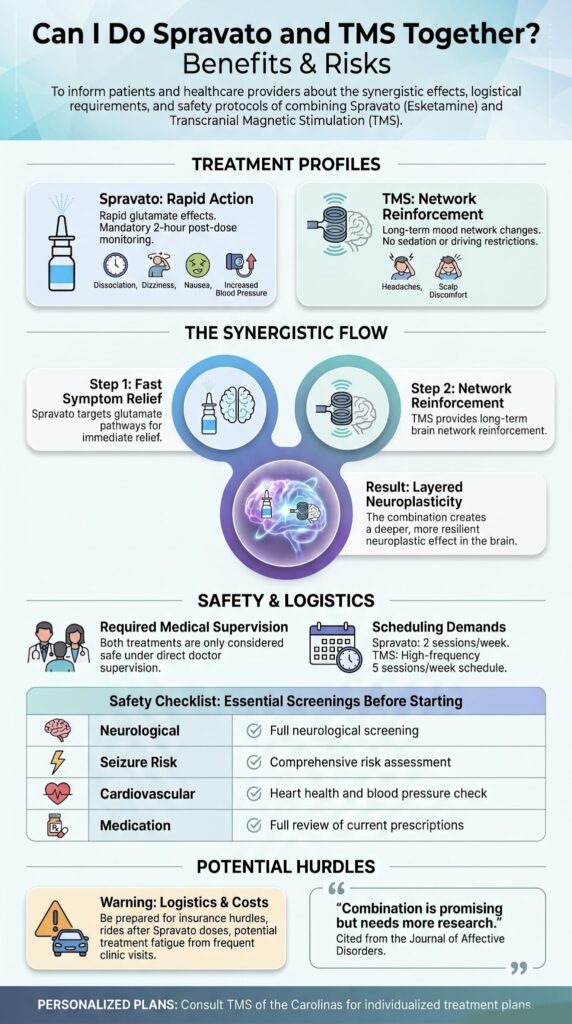
Combining Spravato (esketamine) and Transcranial Magnetic Stimulation (TMS) is becoming a go-to strategy for treatment-resistant depression. Because they target the brain in entirely different ways, they can work as a powerful tag-team without overloading your central nervous system.
Here is a breakdown of how they pair up, what the screening looks like, and why provider oversight is non-negotiable.
How the Combination Works
The clinical safety of pairing these treatments relies on the fact that they have completely different anatomical and neurochemical targets. There is no known direct interaction or dangerous overlap between them.
- Spravato: Works on a molecular level. It targets NMDA receptors to alter glutamate signaling, which triggers rapid neuroplasticity, essentially helping the brain rewire its mood pathways.
- TMS: Works on a structural, electrical level. It uses localized magnetic pulses to physically stimulate neural firing in specific brain regions, primarily the left dorsolateral prefrontal cortex (DLPFC).
Distinct Side Effect Profiles
Because they use entirely separate physiological pathways, their side effects barely touch. This means you aren’t compounding the same systemic stressors.
Spravato Side Effects
- Dissociation (feeling detached from reality)
- Dizziness and nausea
- Temporary spikes in blood pressure
TMS Side Effects
- Mild headaches
- Scalp discomfort at the stimulation site
- Temporary facial muscle twitching during treatment
The Required Screening Protocol
Proper screening is the primary safeguard against adverse events. You cannot skip this step. Before a patient is cleared for dual treatment, they must undergo a rigorous evaluation.
Pre-Treatment Checklist
- Neurological & Seizure Risk Assessment: Crucial for patients who are still exploring what is TMS and whether it is appropriate for their condition, as a history of seizures can be a contraindication.
- Implant Screening: Checking for metallic cranial implants or implanted devices near the head (magnetic fields and metal do not mix).
- Cardiovascular Evaluation: Essential for Spravato due to the temporary blood pressure spikes it can cause.
- Medication Interaction Review: A comprehensive look at current prescriptions to ensure no adverse compounding effects.
- Mental Health Diagnostic Assessment: Confirming the diagnosis and establishing baseline metrics to track progress.
Monitoring and Provider Oversight
Managing both treatments requires a unified strategy rather than separate, messy interventions.
Spravato requires a strict two-hour monitoring window after every single dose to watch for blood pressure changes and dissociation. TMS sessions are much shorter but require precise physical targeting.
Coordinated care allows providers to closely monitor side effects, evaluate how well you are responding to the combination, and safely modify schedules on the fly. Without this oversight, tracking what is actually helping, or causing a side effect, becomes nearly impossible.
Reasons Spravato and TMS Are Often Combined

The treatments work differently. That is why some doctors use them together to treat depression.
In a recent analysis by Journal of Affective Disorders
“highlights the need for large, prospective, comparative effectiveness trials directly comparing these interventions.” – Journal of Affective Disorders
According to the American Psychiatric Association, treatment resistant depression usually means you have tried at least two antidepressants and they did not work well enough. For these patients, combining therapies that target different brain pathways may offer new chances to feel better.
TMS of the Carolina evaluates each patient individually. Not everyone needs combination treatment. We figure that out together.
How Does Spravato Work?
Spravato is a nasal spray form of esketamine. It affects glutamate signaling in the brain.
Research suggests Spravato may do a few things.
- Increase glutamate activity
- Promote neuroplasticity which is the brain’s ability to rewire itself
- Produce faster symptom improvement in some patients
- Support treatment resistant depression management
Here is something important. Traditional antidepressants often take weeks to work. Spravato may work faster for certain people. That can be a big relief.
Before we talk about TMS, you need to understand that these two treatments fix depression in completely different ways. One is not better than the other. They are just different. And that difference matters.
How Does TMS Work?
FDA cleared NeuroStar Advanced TMS Therapy using magnetic pulses. Like little taps. These pulses stimulate brain areas that control mood.
The treatment does not need anesthesia or sedation. Patients stay awake the whole time. You can watch a movie. Or read a book. Or just sit there.
NeuroStar is FDA cleared for several conditions.
- Major depressive disorder (MDD)
- Obsessive compulsive disorder (OCD)
- Anxious depression
NeuroStar is often used for people who did not get better with antidepressant pills. But not everyone can get TMS. Some implanted medical devices get in the way. There are other reasons too. We check everything first.
Why Might the Combination Help?
Okay so here is the idea. Spravato gives you rapid symptom improvement. Like a jump start. TMS helps with longer term network stabilization. Think of it as teaching the brain healthier habits.
Spravato supports fast neuroplastic changes. That means the brain starts rewiring itself quickly. Then repeated TMS therapy for depression sessions reinforce healthier activity inside mood related brain circuits.
Doctors call this the layered neuroplasticity model. It is one of the main explanations for why Spravato and TMS might work better together than alone. Pretty cool right?
Research on Combining Spravato and TMS
While early data is highly encouraging, it is important to keep expectations grounded: the medical community is still in the early stages of researching this dual-therapy approach.
Most of what we know right now comes from real-world clinical experience, retrospective reviews, and smaller case series rather than massive clinical trials.
Here is an honest look at where the research stands today, the data we have, and the massive questions scientists are still trying to answer.
What the Current Evidence Shows
According to emerging data from institutions like the National Institutes of Health (NIH), combining these two heavy-hitters is highly feasible. Because a standard TMS protocol typically spans 4 to 6 weeks, it aligns quite naturally with the intense “induction phase” of a new Spravato schedule.
A recent review published in the Journal of Affective Disorders highlighted some promising statistics regarding how patients actually handle the dual treatment:
- High Adherence Rates: Over 70% of patients undergoing dual therapy were able to complete their full treatment course without needing to pause or suspend sessions.
- Acceptable Tolerability: Side effects did not compound. Patients primarily experienced the expected, temporary post-dose dissociation from Spravato and mild, localized scalp discomfort from the TMS magnetic pulses.
- Robust Effects: Broader literature in Neuropsychopharmacology confirms that both ketamine-based therapies and repetitive TMS (rTMS/TBS) show some of the strongest treatment effects available for Treatment-Resistant Depression (TRD).
A Snapshot of the Data
To look at it objectively, the current landscape of combined Spravato and TMS therapy can be broken down by what the data actually tells us:
| Research Area | Current Findings |
| Safety Profile | Generally well-tolerated in properly screened candidates. |
| Effectiveness | Promising, robust symptom improvement reported in clinics. |
| Remission Rates | Early signals are highly encouraging but statistically limited. |
| Evidence Quality | Small. Large-scale randomized controlled trials are still lacking. |
Major Questions Researchers Still Need to Answer
Because we lack large, double-blind randomized trials, clinicians are essentially customizing protocols based on experience rather than a standardized rulebook.
The Scheduling Dilemma
Should a patient receive Spravato and TMS on the exact same day, or should they alternate days? If they are on the same day, does the order matter? (e.g., TMS before or after the esketamine nasal spray?)
Long-Term Durability & Maintenance
Once a patient achieves remission, how do we keep them there? Doctors are still figuring out the best maintenance strategies, including how often a patient should return for “booster” sessions of either treatment over the span of 6 months to a year.
Patient Selection Criteria
While both treatments target depression, we still don’t have clear biomarkers to predict who will benefit most from the combination versus who would do just fine on one therapy alone.
Current Limitations in the Data
The reason medical guidelines aren’t set in stone yet comes down to a few distinct roadblocks in the current data:
- Small Study Populations: Most published papers look at small groups of patients at specific clinics rather than thousands of diverse participants.
- Protocol Variation: One clinic might use traditional rTMS while another uses rapid Theta Burst Stimulation (TBS), making it hard to compare results accurately.
- Lack of Control Groups: Without “sham” (placebo) TMS or placebo nasal sprays to compare against in a large trial, it is tough to scientifically prove exactly how much the combination is outperforming the individual treatments.
As clinical trials expand, these procedures will become more standardized, leaving much less room for guesswork. For now, however, the best outcomes typically come from close collaboration between healthcare providers. If you are considering this route, your first step should always be a unified conversation with your psychiatrist or treatment team.
Patient Experiences: Successes, Challenges, and Concerns
When we track how patients actually fare when combining Spravato and TMS, the picture gets complicated. People talk openly on forums like Reddit. They share everything.
While these stories are not formal clinical trials, they matter. They show us what happens when medicine meets real life.
Benefits Patients Talk About
For many people, this combination brings real relief when nothing else works.
- Real Progress: Many patients finally see a shift after trying multiple standard antidepressants that failed them.
- Fast Relief: Some report that their heavy symptoms start lifting much faster than they ever did with older therapies.
- Breaking Through: If a patient only gets a partial response from one treatment, adding the second can sometimes bridge the gap. It pushes them toward remission.
- Hope: For individuals who have battled chronic depression for years, it provides a renewed sense of possibility. Truly.
The Actual Daily Grind
But undergoing both therapies at the same time is a massive commitment. It is exhausting. Patients frequently run into major hurdles that doctors might not always think about.
- Money Strain: Navigating insurance denials and high copays is incredibly frustrating. The out of pocket costs stack up fast.
- Getting Around: Spravato requires a strict observation period in the clinic. Because of that, patients cannot drive themselves home. They must find rides.
- The Schedule: Managing multiple appointments each week feels like a job. A heavy one. During the most intense weeks, patients often sit in a clinic four or five times a week.
In observing patients undergo this intensive regimen, the primary barrier to clinical success is rarely physiological tolerance, but rather therapeutic exhaustion.
Achieving optimal outcomes and long-term network stabilization requires strict adherence to a demanding calendar, frequently demanding up to five clinic visits per week during the active induction phase.
Side Effects of Receiving Spravato and TMS Together
One main reason we even consider putting Spravato and TMS together is because their side effects do not really overlap, a distinction often highlighted when comparing TMS Therapy vs Spravato (esketamine). They affect the body in completely different ways. That is actually a good thing for safety.
Here is how the two treatments break down when you compare them side by side.
| Treatment | Common Side Effects | Monitoring Requirements |
| Spravato (Esketamine) | Dissociation, dizziness, nausea, temporary increases in blood pressure, sedation | Requires in-clinic administration and approximately two hours of post-treatment observation |
| FDA-Cleared TMS | Headache, scalp discomfort, facial muscle twitching | Routine treatment monitoring with no post-session observation period required |
| Combined Treatment Consideration | Side effects generally do not overlap significantly | Ongoing provider coordination and symptom monitoring are recommended |
What to Watch Out For
With TMS, the risk of a serious seizure is incredibly rare. We screen patients very carefully beforehand to make sure they are safe candidates.
Spravato is a different story. The monitoring requirements are much more intense. We keep patients in the office for at least two hours because the drug can temporarily alter your perception.
It affects your alertness. It bumps up your blood pressure right after you take it. We watch you the whole time.
When to call us: You must contact your care provider immediately if you notice persistent side effects, big changes in your blood pressure, or new neurological issues. The same goes for a worsening mood or any suicidal thoughts.
Communication is everything here. We need to know what you are feeling so we can keep you safe.
Common Discussions About Insurance, Scheduling, and Burnout

From a clinical perspective, we often find that the administrative hurdles wear patients down faster than the actual treatments. It is an exhausting reality.
When you look at online support groups, people rarely debate brain science. Instead, they talk about the paperwork. They talk about the logistics.
Navigating the Insurance Maze
Getting approval for these therapies takes serious effort. The insurance barriers discussed in many conversations about TMS therapy cost are constant, and they cause real stress.
- Prior Authorization: Insurance companies require massive amounts of paperwork before they will cover even one session.
- Strict Coverage Rules: Plans often have rigid limits on who qualifies, forcing us to prove you failed multiple other drugs first.
- Same-Day Billing Rules: Many companies refuse to pay for two different mental health treatments on the exact same day. It makes scheduling a nightmare.
- Constant Documentation: We have to constantly send in progress notes just to keep your approval active.
The Calendar Chaos
During the active phase of treatment, your schedule changes completely. It becomes a massive puzzle.
- Rides and Work: Spravato requires a designated driver every single time. Plus, patients have to miss hours of work, which puts jobs at risk.
- Family Obligations: Finding childcare or managing household duties becomes incredibly difficult when you live at the clinic.
- Too Many Appointments: A typical intensive week can mean four separate TMS sessions plus a Spravato session. That is five visits in five days. Truly.
Facing Treatment Fatigue
Over time, a very real exhaustion sets in. We call it treatment fatigue.
- Burnout: Patients experience deep emotional exhaustion from focusing on their depression day after day.
- Money Stress: The copays and hidden costs add up, creating a heavy financial strain.
- The Wall: Eventually, people hit a wall. They get appointment fatigue. It becomes harder and harder to just show up and maintain the schedule.
The Medical Reality: Because of these heavy burdens, we must do realistic treatment planning before your first session. We need a solid plan for your rides, your budget, and your time. Ambition is great. But preparation keeps you in treatment long enough to actually get well.
Ideal Candidates for Combined Spravato and TMS Treatment
When we think about recommending a combination of Spravato and TMS, we usually reserve it for people with severe or treatment resistant depression. These are individuals who simply did not get better using traditional approaches like standard antidepressants or basic therapy.
Before we suggest anything, we look at your complete medical history. We look at how severe your symptoms are, and what your goals look like.
Who We Consider for Both Treatments
It is not for everyone. We look for specific signs that a patient needs this intensive, double approach.
- Treatment Resistance: You tried multiple different medications at the right doses, but your depression barely budged.
- Partial Success: Maybe a previous therapy helped a little bit, but you are still stuck far away from feeling like yourself.
- Severe, Chronic Symptoms: Your depression is heavy. It has lasted for a long time, making daily life incredibly difficult.
- The Need for Speed: Sometimes, a patient is in a dark place and needs their symptoms to start lifting much faster than standard pills allow. Speed matters.
Who Can Skip the Combination
We never want to overtreat. Many patients do beautifully without combining these therapies.
- Doing Well on One: If you are already making great progress with just TMS or just Spravato, there is no clinical reason to add the other. One is enough.
- Medical Red Flags: Some patients have health conditions, like certain blood pressure issues or metal implants, that mean one of these treatments is just not safe for them. Safety first.
- Milder Symptoms: If your depression is less severe or if you are looking for a lower intensity approach, we look at other options first.
To be very clear, advanced therapies like NeuroStar TMS are not meant for mild depression. And we do not use them as a first line choice if your current medications are already working well. We use them when we need to bring out the heavy artillery.
Typical Schedules for Spravato and TMS Therapy
Scheduling these procedures varies a lot based on your clinic, your insurance rules, and how you actually respond to the medicine. Many treatment centers prefer to customize the timing, and they base it on how severe your symptoms are, your personal schedule, and what you prefer.
Every patient is a puzzle we try to piece together.
| Treatment | Typical Frequency |
| TMS | Often 5 days per week initially |
| Spravato | Often 2 times weekly during induction |
Designing the Calendar
A standard initial round of TMS usually requires 20 to 30 sessions, so it takes up a lot of weeks. Because of that, we have a few different ways to map out your calendar.
- Concurrent Treatment: We run both therapies at the exact same time. It is a lot of appointments at once, but it gets everything moving.
- Staggered Starts: We might start you on one treatment first to see how you handle it, then we layer in the second treatment a few weeks later.
- Sequential Plans: You finish a full course of one therapy completely before you even start the other one.
- Coordinated Maintenance: Once you are feeling better, we carefully space out the remaining sessions for both treatments so you stay stable.
But it requires a lot of moving parts. Some clinics will administer both therapies during overlapping weeks, and others prefer the step by step method.
The Same Day Dilemma
Trying to do TMS and Spravato on the exact same day can get very tricky. It sounds efficient, but we have to look at several major factors first.
- Insurance Rules: Many insurance policies have strict clauses that ban same day billing for two major mental health procedures.
- Clinic Rules: Every office has its own protocol for how they manage their staff and rooms.
- Monitoring Needs: Spravato requires you to sit in a chair and be watched for two hours, which eats up a massive part of your day.
- Rides: You absolutely cannot drive after Spravato, so your transportation has to be locked down.
Right now, there is no single, universal rulebook for combining Spravato and TMS. Medicine is still figuring out the absolute perfect blueprint. But we work closely with you to build a schedule that actually fits your life.
Important Questions to Ask Before Starting Spravato and TMS

Before we even think about scheduling your first appointment, you need a clear grasp on the whole picture. The costs. The calendar. The side effects.
It is a lot to take in. And frankly, the insurance approval process alone can drag things out for weeks before we can even touch a machine or a nasal spray.
You have to be prepared.
Critical Safety Questions
Safety comes first. Always. Before we start, we need answers to these specific questions.
- Am I actually a candidate for both? Just because they can be combined does not mean your specific brain and body need both.
- Are there any medical red flags? We must check if you have any contraindications, like metal in your head or unsafe blood pressure, that make these therapies dangerous for you.
- What side effects are coming my way? You need to know exactly what you are going to feel during and after the sessions so you do not panic.
The Logistical Puzzle
The math of your weekly schedule can get overwhelming. It is basically a logistics game.
- Can we do both on the same day? Sometimes it works. But often, insurance rules or your own exhaustion levels say no.
- Who is actually running the show? You need to know which doctor or case manager is coordinating your overall care plan so things do not fall through the cracks.
- How does the money work? We need a clear answer on your copays and what your insurance actually covers before you get hit with a surprise bill.
Measuring Success
We do not just guess if you are getting better. We track it.
- How do we measure your progress? We use specific clinical rating scales to watch your depression score drop. It gives us real data.
- What does winning look like? For some, success means total remission and feeling completely normal. For others, it means just being able to get out of bed and go to work again.
- What if one treatment completely flops? If TMS does nothing but Spravato helps, we pivot. We need a backup plan.
Final Thoughts on Combining Spravato and TMS
Living with treatment-resistant depression can leave you feeling stuck, especially when previous treatments haven’t brought enough relief. That’s frustrating. The good news is that combining Spravato and TMS may offer another path forward for some people by working on different areas of brain function that are linked to depression.
If you’re looking for a treatment plan built around your specific needs, TMS of the Carolina can help you explore whether this approach makes sense for you. A personalized evaluation can provide clear guidance and help you understand your options. Schedule a consultation today through TMS of the Carolinas and take the next step toward finding a treatment plan that fits your goals.
FAQ
Can combining Spravato and TMS improve results after previous treatments failed?
Patients diagnosed with treatment-resistant depression frequently explore the combination of esketamine nasal spray and transcranial magnetic stimulation when multiple courses of standard oral antidepressants fail to induce remission. Combining these two modalities allows us to target disparate neural mechanisms simultaneously.
Esketamine targets the glutamate pathway TMS Spravato researchers often study, while TMS uses targeted brain stimulation. This brain stimulation medication combination may help some patients achieve greater symptom reduction than either treatment alone.
Is Spravato safe with TMS for people with anxiety or OCD symptoms?
Patients frequently ask, “is Spravato safe with TMS” when they also experience anxiety or obsessive-compulsive symptoms. A provider will evaluate medical history, current medications, and symptom severity before recommending a TMS and esketamine combination.
Some clinicians use Spravato TMS anxiety relief strategies for patients with depression and anxiety. Others may consider Spravato TMS OCD treatment when depression remains the primary condition requiring treatment.
How do doctors determine whether someone is a good candidate?
Spravato TMS patient selection involves a detailed review of diagnosis, previous treatments, and medical history. Providers assess contraindications Spravato TMS concerns, including seizure risk Spravato TMS factors and the presence of a metallic implant TMS Spravato restrictions may affect.
Patients with chronic depression, severe depression, or refractory depression Spravato TMS cases are often evaluated for this approach when standard treatments have not provided sufficient relief.
What side effects can occur during a Spravato TMS treatment plan?
Spravato TMS side effects may include dizziness, nausea, dissociation, temporary increases in blood pressure, and changes in perception. Some patients experience Spravato dissociation TMS effects shortly after treatment sessions.
Clinics typically follow Spravato clinic monitoring TMS procedures and check for Spravato blood pressure TMS changes before discharge. TMS commonly causes mild scalp discomfort or headache, but it does not require sedation or anesthesia.
How much does a Spravato TMS combination therapy program cost?
The total Spravato TMS cost depends on treatment frequency, clinic location, insurance benefits, and the length of the Spravato TMS treatment plan. Some insurance providers offer partial or full Spravato TMS insurance coverage when medical necessity requirements are met.
Patients should contact both their insurer and treatment provider for specific cost estimates because coverage rules, copays, and authorization requirements vary significantly.
References
- https://pmc.ncbi.nlm.nih.gov/articles/PMC12032262/
- https://pubmed.ncbi.nlm.nih.gov/41245530/