
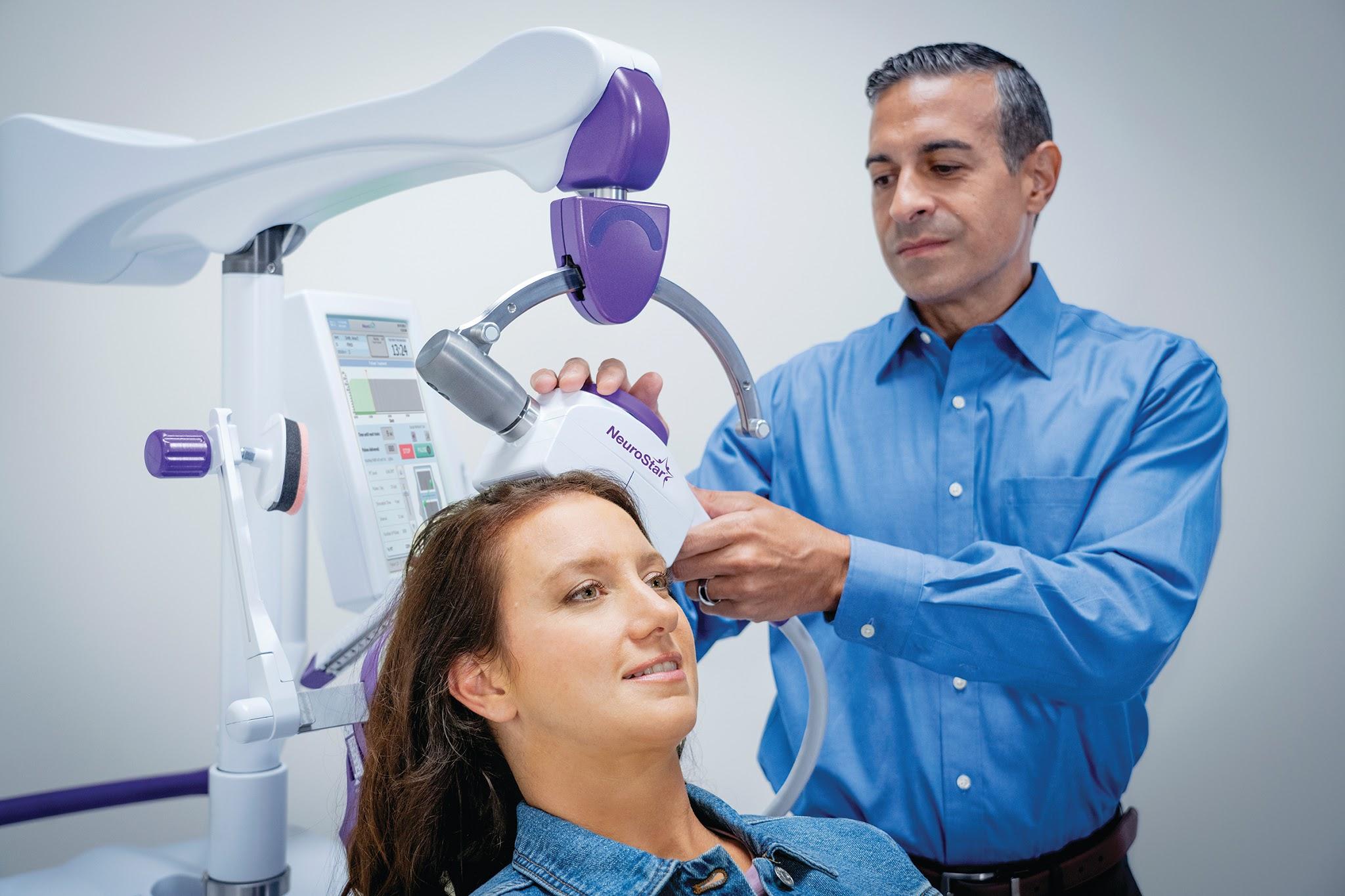
How long does TMS take to work for anxiety? Most patients who respond notice gradual improvements after three to six weeks of daily sessions. However, response timelines vary because current clinical evidence does not establish a uniform schedule across every type of anxiety disorder. Transcranial magnetic stimulation (TMS) uses focused magnetic pulses to stimulate specific brain circuits across several weeks.
At TMS of the Carolinas, your treatment plan will depend on your needs and diagnosis. This guide explains what to expect during treatment and which factors may affect your response to TMS.
Key Takeaways
- Potential Early Changes: Some patients may report changes during the first few weeks, although the timing is uncertain.
- Treatment Response: There is no established week-by-week timeline for TMS across primary anxiety disorders.
- Individual Results: Responses vary by diagnosis, protocol, and patient.
What Is the Typical TMS Timeframe for Anxiety?
There is no single answer. How long TMS takes to help with anxiety depends on your diagnosis, your treatment plan, and your own body. Some people feel better within a few weeks. Others take longer, and some don’t improve much.
Early sessions may not produce noticeable changes. Your clinician can help you track symptoms and assess your progress throughout treatment. You may notice changes in sleep, tension, or daily functioning before you notice a broader change in anxiety. These observations can be useful to discuss with your clinician, but they do not guarantee that TMS will be effective.
During treatment, some patients report changes in anxiety symptoms or daily functioning, while others notice little or no improvement. Changes in activity levels or avoidance behaviors may be worth discussing with your clinician, but short-term fluctuations do not necessarily indicate a sustained treatment response.
The amount of improvement varies. Some people report meaningful changes, while others experience limited improvement or no benefit. Because evidence varies by anxiety diagnosis and TMS protocol, there is no universally established timeline for improvement in primary anxiety disorders. Understanding the available evidence for TMS therapy for anxiety can help patients discuss realistic expectations and treatment options with their clinician.
If you do not notice improvement early in treatment, that does not necessarily mean TMS will be ineffective. However, extending treatment does not guarantee better results. Your clinician can assess your progress and determine whether your treatment plan should be continued or adjusted.
A daily symptom log can help you and your clinician monitor changes during treatment. Record anxiety severity, sleep, concentration, avoidance behaviors, and daily functioning. Your clinician can compare these observations with your baseline symptoms and standardized assessments to evaluate your response.
What Affects the TMS Timeframe for Anxiety?
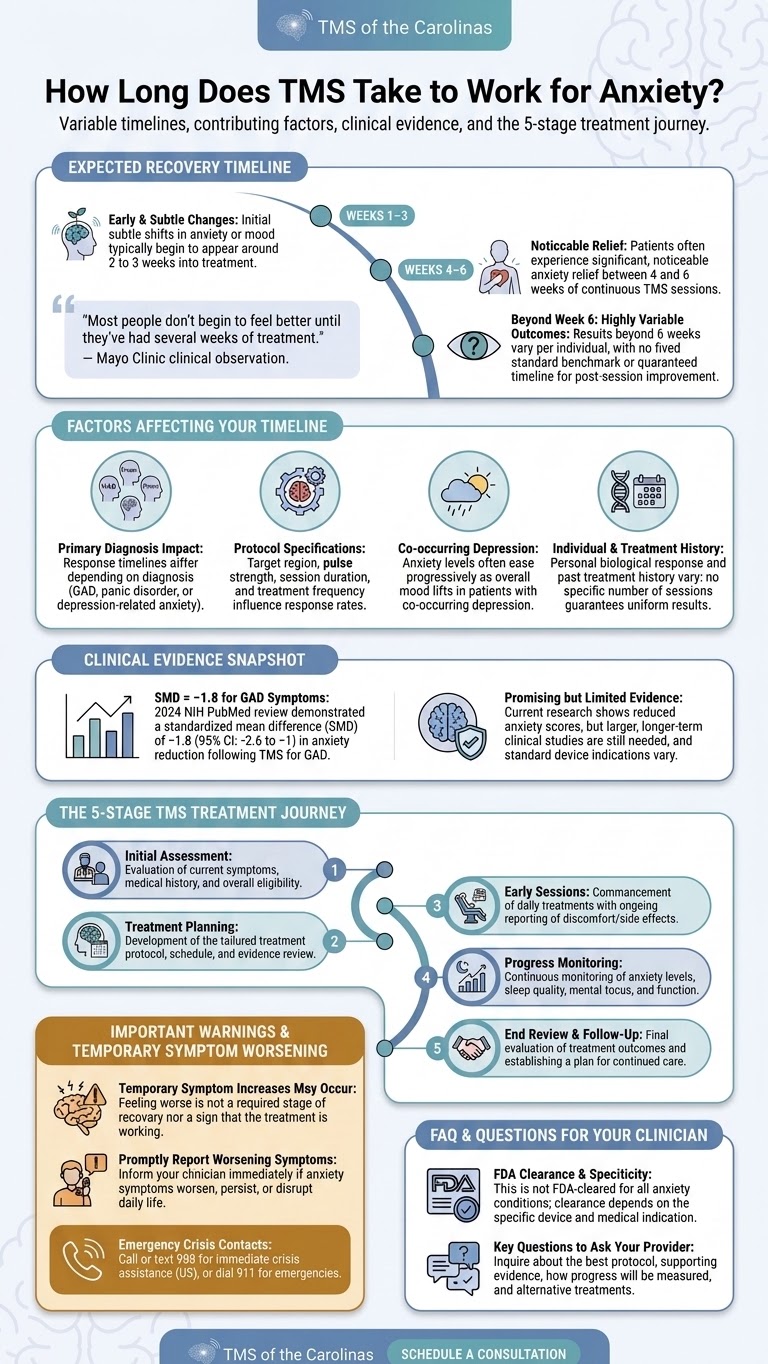
A few things can change how quickly you respond: your diagnosis, the TMS protocol, how severe your symptoms are, and whether you have other mental health conditions.
Diagnosis. Generalized anxiety disorder (GAD), panic disorder, and anxiety that comes with major depression are different conditions. If TMS helps one of them, that doesn’t prove it helps the others.
A 2024 review of brain-stimulation studies for generalized anxiety disorder (GAD) reported reductions in anxiety symptoms with some stimulation techniques. However, differences in study methods, sample sizes, and follow-up periods limit the conclusions that can be drawn. Larger, longer-term studies are needed to clarify the effectiveness of specific TMS protocols and determine whether a consistent response timeline exists.
Data from NIH PubMed demonstrates
“TMS for symptoms of generalized anxiety disorder (SMD = -1.8 (95% CI: -2.6 to -1)).” – NIH PubMed
Protocol. TMS protocols differ in stimulation target, intensity, session duration, and treatment frequency. These differences matter because evidence for one protocol or diagnosis cannot automatically be applied to another. Understanding does TMS works for anxiety can help explain how these protocol differences relate to treatment. A TMS protocol studied for depression should not automatically be assumed effective for a primary anxiety disorder. The evidence depends on the condition being treated, the stimulation protocol, and the outcomes measured in clinical studies.
Depression. Some people have anxiety as one part of major depression. When the depression eases, the anxiety may ease with it.
Past treatment. Tell your clinician what you’ve tried, how it worked, and whether you had side effects. This helps them pick the best next step.
Personal response. Two people with the same symptoms can get different results from the same treatment. No number of sessions can guarantee improvement.
What Should You Know About TMS Treatment for Anxiety?
During the initial assessment, your clinician reviews your symptoms, medical history, previous treatments, and treatment goals. They also assess potential contraindications and other safety considerations before determining whether TMS is appropriate for your situation.
If you go ahead, you’ll follow a set schedule. Many conventional TMS courses involve weekday sessions over several weeks. Your schedule depends on the prescribed protocol, device, and condition being treated. Ask how long each visit lasts and how often you’ll need to come.
During treatment, your clinician may monitor anxiety severity, sleep, concentration, and daily functioning. These assessments help evaluate your response and determine whether further evaluation or a change in the treatment plan is appropriate.
| Treatment Stage | What Happens | What to Discuss With Your Clinician |
| Initial Assessment | Your clinician reviews your symptoms, medical history, and previous treatments to determine whether TMS may be appropriate. | Your diagnosis, treatment history, and factors that may affect your eligibility for TMS. |
| Treatment Planning | Your clinician determines the treatment protocol and schedule based on your needs and diagnosis. | The stimulation protocol, session duration, treatment frequency, and evidence supporting its use for your condition. |
| Early Sessions | You begin receiving magnetic stimulation and can report any discomfort or side effects. | Your comfort during treatment, side effects, and any changes in anxiety symptoms. |
| Progress Monitoring | Your clinician assesses changes in anxiety, sleep, focus, and daily functioning throughout treatment. | Whether your symptoms are improving and whether your treatment plan needs adjustment. |
| End-of-Course Review and Follow-Up | Your clinician reviews symptom changes, daily functioning, side effects, and progress toward treatment goals to discuss appropriate follow-up care. | Your treatment outcomes, continued care options, and what to do if symptoms persist or return. |
Before starting treatment, ask whether the proposed TMS device and protocol have an FDA-cleared indication for your diagnosis. NeuroStar has specific FDA-cleared indications. Before publication, verify the exact indications against the current FDA documentation and manufacturer labeling, then summarize each relevant indication once.
FDA clearance applies to specific device indications and should not be interpreted as clearance for every anxiety disorder. Before starting treatment, verify the proposed device’s current FDA-cleared indications and ask your clinician what evidence supports its use for your diagnosis.
During your initial consultation, we encourage an open dialogue about your specific diagnosis. Patients considering TMS therapy in Fayetteville, NC should ask which brain region the proposed protocol targets, what evidence supports its use for their diagnosis, and how it differs from protocols used for depression. Ask about side effects, about who shouldn’t get TMS, and about other treatment choices.
To learn more about TMS for depression, read the clinic’s article on how effective TMS is for depression. Evidence that TMS helps depression does not establish that it is equally effective for GAD, panic disorder, or other primary anxiety disorders. Ask your clinician what condition-specific evidence supports the proposed treatment.
Can TMS for Anxiety Make Symptoms Worse Before They Improve?
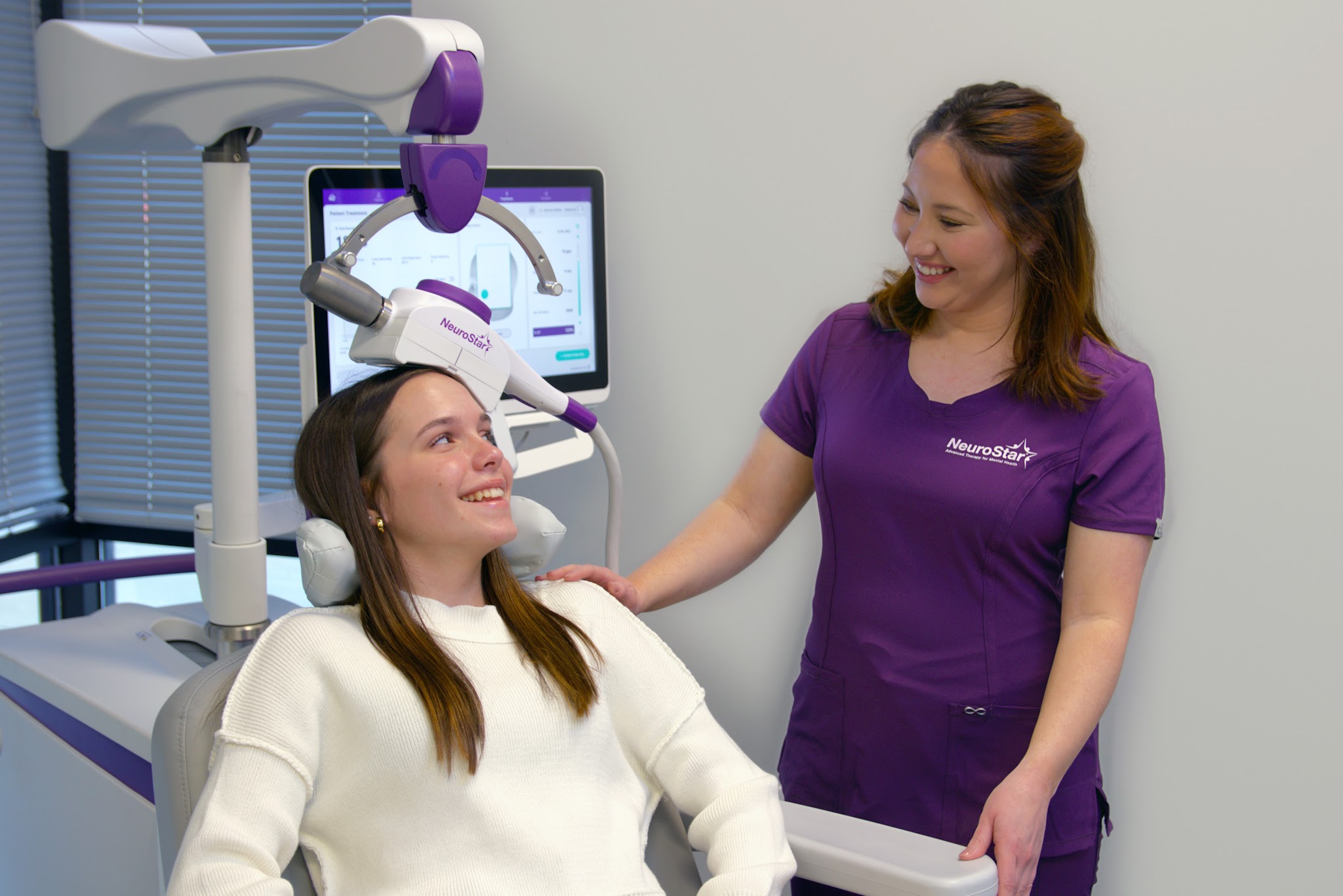
Tell your clinician if your symptoms intensify so they can assess possible triggers and adjust stimulation settings.
They can assess the severity, review possible contributing factors, and determine whether changes to your care are needed.
If your anxiety goes up, there are many possible reasons. Poor sleep, a change in your medication, a stressful week, or the usual ups and downs of anxiety can all play a role.
It’s also worth knowing that feeling worse does not mean the treatment is working. If your symptoms get stronger, last longer than usual, or make daily life harder, tell your doctor. They can look at what is going on and decide whether your treatment plan should change. Because individual responses vary, understanding the success rate of TMS for anxiety also requires considering the diagnosis being treated and the limitations of the available clinical evidence.
It helps to keep simple notes before your visit. Write down when your symptoms change and how bad they get. Also note any changes in your sleep, medication, focus, or daily routine. These details give your doctor a clearer picture.
Get medical advice soon if your symptoms get much worse or do not go away. If you are in a mental health crisis or might hurt yourself, call or text 988 (the Suicide & Crisis Lifeline) in the United States. If it is an emergency, call 911.
What Should You Remember About TMS for Anxiety?
TMS may help some people with anxiety symptoms, but individual responses vary by diagnosis and protocol. At TMS of the Carolinas, treatment is delivered with NeuroStar TMS Therapy, which is FDA-cleared for depression and can also reduce the anxiety symptoms that often come with it.
Before deciding, ask your clinician what evidence supports TMS for your diagnosis, which protocol is being proposed, how progress will be assessed, and what alternatives are available. Contact TMS of the Carolinas to discuss your treatment options and whether NeuroStar TMS Therapy may be appropriate for your needs.
FAQ
How Long Does TMS Take to Work for Anxiety?
Most individuals who respond notice gradual relief between three and six weeks of consistent appointments, though response rates vary depending on personal biology, diagnosis, and the prescribed clinical protocol.
Can TMS for Anxiety Make Symptoms Worse Before They Improve?
Some people experience changes in anxiety or mood during TMS, but worsening symptoms are not a required stage of treatment. If symptoms become more severe, persist, or interfere with daily life, contact your clinician for an assessment. Seek urgent help if you experience a mental health crisis or feel at risk of harming yourself.
Can Anxiety Improve After the Last TMS Session?
Some people report continued improvement after their final TMS session, but the likelihood and timing are uncertain. Follow-up appointments can help assess changes in symptoms and determine whether additional care is appropriate.
How Long Can the Benefits of TMS for Anxiety Last?
The duration of improvement varies, and there is no established universal timeframe for anxiety relief after TMS. The available evidence does not allow a reliable prediction of how long benefits will last for every anxiety disorder.
Is TMS Cleared by the FDA for All Anxiety Disorders?
No. FDA clearance applies to specific devices and indications, not every anxiety disorder. Ask your clinician whether the proposed device has an FDA-cleared indication for your diagnosis and what evidence supports its use for your condition.